More than 8,000 book bans in Texas public schools in 2025-26 academic year, report says
A new report by PEN America says that US public schools banned books nearly 12,000 times in the last school year.
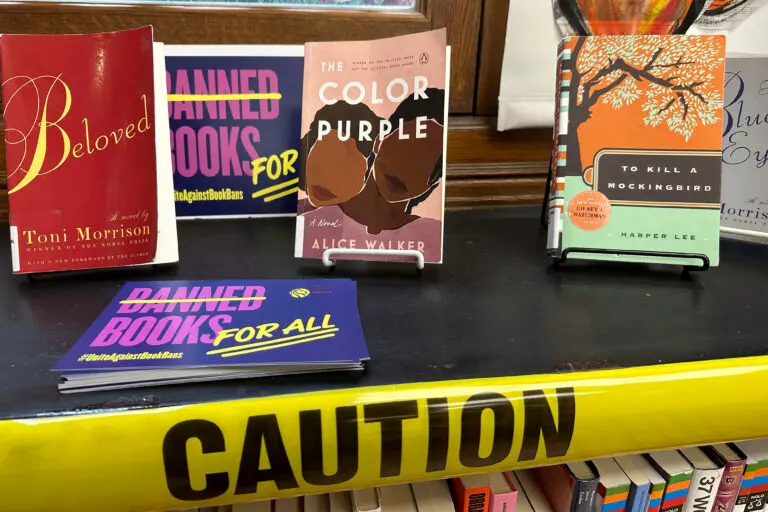
U.S. public schools banned books nearly 12,000 times during the 2025-26 school year, the most in a single year since PEN America began tracking bans in 2021, according to a new report from the free expression organization.
PEN America counted 7,370 different titles banned in public schools during the 2025-26 school year, by more than 4,000 authors, illustrators, and translators. More than 4,500 of the banned titles had not appeared in the group’s Index of School Book Bans before, according to the report, a sign that the bans keep reaching new books. A record 114 school districts banned books during the school year, up from 87 the year before.
PEN America defines a school book ban as “any action taken against a book based on its content and as a result of parent or community challenges, administrative decisions, or in response to direct or threatened action by governmental officials, that leads to a book being either completely removed from availability to students, or where access to a book is restricted or diminished.”
Philomena Polefrone, senior manager of PEN America’s Freedom to Read initiative, told the American Independent that PEN America first began tracking schoolbook bans during the 2021-2022 school year. “In that first year, there were 2,500 instances of bans, which was already just on another scale from what it had been historically in the United States,” she said.
According to the new report, 58% of the books banned during the last school year are categorized as young adult, and 87% are fiction. Asked whether books concerning personal identity continue to be banned, Polefrone said: ” It definitely is still the case. We have a ton of new titles that were added to the index this year that we’ll be doing content analysis of in the coming months, but based on the repeat bans, we can absolutely see that those identity-based trends continue. Authors of color, women, LGBTQ+ authors, and anything touching on social activism has kind of a lightning rod attached to it in terms of book bans.”
Polefrone said bans on young adult fiction add to current crises in literacy and in reading for pleasure.
“It would be easy to blame social media, right?” Polefrone said. “I think that when young people have more access to things that are just working on a different attention span than reading does, it becomes, I think, harder to find that level of reading, but I think also book bans make that problem worse because I think that people are more likely to target or be suspicious of contemporary fiction that reflects the complicated world that we live in. Which, for me, I think that’s exactly the kind of thing that I would want young people going to books to try to understand. But those are actually the books that tend to get most banned. So I think that book banning contributes to the literacy crisis in the sense that young people are going to the library and are now less likely to find books that are going to speak to them.”
The report says that the majority of the recorded book bans were instituted in Texas and Florida. More than 8,100 were recorded in Texas, while Florida had more than 3,200. PEN attributes the Texas surge to a state law enacted in 2025 that allows school boards to ban broad categories of books in schools.
Polefrone said that the government in Florida has been responsible for many of the bans in that state: “We were tracking the impact when the Florida Board of Education called the Hillsborough superintendent in front of a hearing and basically said that its school administrators or librarians who were allowing certain books in libraries were child abusers, I think that’s a direct quote, and really just had this intimidation session as part of this hearing. That impacted not only Hillsborough, which went on to pull many of the books named and many others, but also a ton of other districts around the state.”
Polefrone pointed to an Aug. 19 press conference at which Texas Lt. Gov. Dan Patrick presented displays of the covers of several books which, the Texas Tribune reported, he said were “so filthy, so dirty, so vulgar, so pornographic” that his respect for the women in the room prevented him from opening them. Patrick said he would push to pass legislation that penalized schools that did not remove specified books from their library shelves.
“There are no books banned in America,” he said. “You can buy any book you want to buy if you want it. But we do not take taxpayer money and buy these books for our schools.”
“So even without getting into legislation, which is a problem on its own, there are all these actions that state politicians are taking that are just creating this deep chilling effect,” Polefrone said.
A new trend, the report finds, is the use of artificial intelligence tools to select books to be banned. PEN records show that when the decision on whether or not to ban a book is made by AI, it consistently recommends the book be removed from school shelves, “not because those books are obscene under the prevailing legal standard, but instead because other districts have banned them,” the report says.
“Librarians are expertly trained. It is their job to get the right book into the hands of the right reader, and it’s work that they take pride in and do very, very well. In a lot of these book ban situations, it’s that expertise that is being overridden by administrators, by school boards, by organized pressure groups, by politicians who are saying, ‘Actually, we haven’t read this book, but we’re pretty sure we know better than those librarians. And I don’t like the look of this one.’ So, if you want your kids to be guided in their reading by an expert who’s really invested in their well-being and also in their reading, trust your librarians,” Polefrone said.