Cooper and Whatley vie for open North Carolina US Senate seat
Democrat Roy Cooper and Republican Michael Whatley have vastly different views on education, the economy, and healthcare.
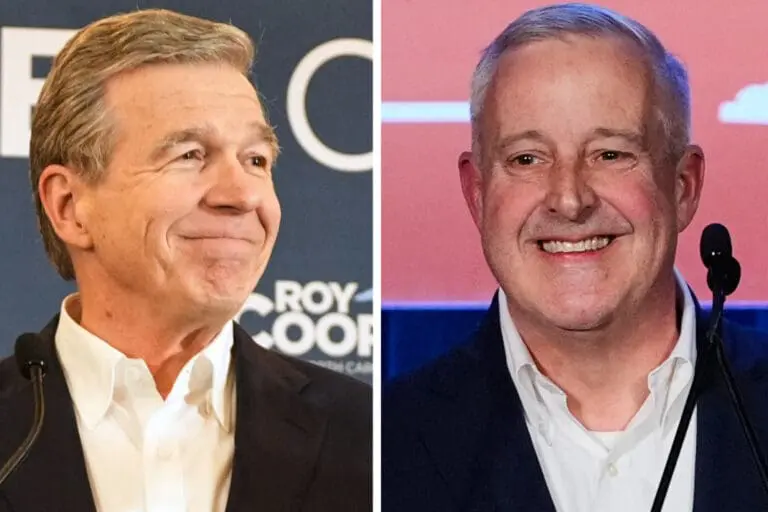
Former North Carolina Gov. Roy Cooper, a Democrat, and Michael Whatley, a former Republican National Committee chairman, will face off for the state’s open U.S. Senate seat after winning their respective primaries in March.
The seat is currently held by Republican Sen. Thom Tillis, who served two terms before announcing he would not be seeking reelection in June 2025. With Republicans and Democrats fighting for control of the Senate in this year’s midterm elections, the North Carolina race is anticipated to be one of the more competitive seats up for grabs, although the Democratic Party has a slight advantage, according to Cook Political Report rankings.
Cooper and Whatley, who will appear on the general election ballot in November, have vastly different records and opinions on key issues affecting North Carolinians.
Public Education
Cooper is a strong advocate of public education and has received the endorsement of the North Carolina Association of Educators, the state’s school employee union, and the National Education Association. In a press release, Tamika Walker Kelly, president of the North Carolina Association of Educators, called Cooper “a champion for our public schools, our educators, and North Carolina’s working-class families.” As governor, Cooper proposed raising teacher pay by 8.5% during the 2024-2025 fiscal year, as well as investing over $1 billion in North Carolina’s public school system.
Whatley, who has received the endorsement of President Donald Trump, is an advocate for school choice. He promoted the Education Freedom Tax Credit program alongside U.S. Education Secretary Linda McMahon during a March press conference in High Point. The Education Freedom Tax Credit, enacted as a part of the One Big Beautiful Bill Act budget bill that Trump signed into law in 2025, allows taxpayers to claim a tax credit of up to $1,700 for donations made to nonprofits that fund K-12 scholarships that help families pay for private schooling and other educational expenses. North Carolina is among the states that have not opted in to the program. The use of public funding for private educational expenses has been heavily criticized by public school advocates and educators, such as the American Federation of Teachers union, for taking funding away from already underfunded school systems.
Economy
Cooper has made several campaign promises that he believes will lower costs for North Carolinians. If elected to the Senate, he says he will support farmers and stop tariffs, which Trump has sporadically implemented, paused, and reduced during his second term in the White House.
Trump’s tariff plan has negatively affected North Carolina’s economy: North Carolina Attorney General Jeff Jackson said in an April 2026 statement that they have cost families and businesses throughout the state $3.5 billion. Tariffs could also have devastating consequences for the state’s rural population, as retaliatory tariffs imposed on U.S. exports by American trading partners such as China, Canada, and Mexico could cost North Carolina farmers about $695 million, nearly one-third of the average net farm income in the state.
Whatley has supported Trump’s tariff strategy. In a July 2025 interview with Main Street Matters host Alfredo Ortiz, Whatley said about Trump’s tariff plan: “His strategy of flipping the table and putting tariffs on everybody and saying, ‘Come back to the negotiating table if you want to bring these tariffs down’ has been record-setting in terms of its effectiveness.”
Healthcare
In 2023, Cooper signed into law the state’s Medicaid expansion program, which has helped hundreds of thousands of low-income North Carolina residents pay for healthcare. During his Senate campaign, he has said he would help reverse Medicaid cuts that were passed under the 2025 Republican budget law and reinstate Affordable Care Act premium tax credits that expired at the end of 2025.
The cuts included in the budget law are anticipated to threaten healthcare access throughout the state: More than 670,000 Medicaid recipients are at risk of losing their healthcare coverage due to the federal funding cuts, and an additional 500,000 could lose coverage following the expiration of the marketplace premium subsidies.
Whatley is a proponent of the budget law, which includes $1 trillion in Medicaid cuts over a period of 10 years. He called it a “huge win for all Americans!” in a post on X the day the House of Representatives passed the final version of the bill. His campaign spokesperson, Jonathan Felts, told Politico that Whatley supported the law’s Medicaid provisions: “Michael Whatley supports cutting illegal aliens from getting taxpayer-funded Medicaid, cutting weasels who were fraudulently filing for Medicaid in multiple states, and adding a work requirement for able-bodied adults.”