Justice Anita Earls faces Republican Sarah Stevens in Supreme Court reelection bid
North Carolina’s high court currently has a 5-2 Republican majority.
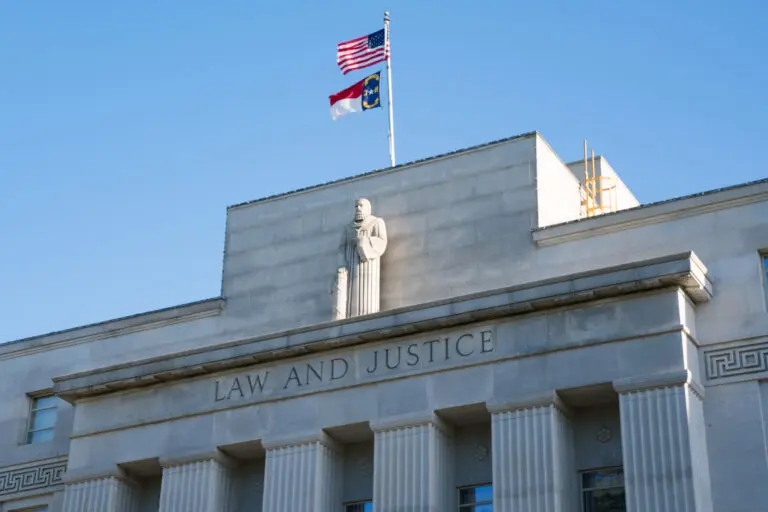
Democratic Justice Anita Earls is seeking reelection to the North Carolina Supreme Court against challenger Sarah Stevens, a former Republican member of the state House of Representatives, in the general election on Nov. 3.
Earls, whose current term expires at the end of this year, was first elected to the Supreme Court in 2018 and is the court’s only Black justice.
Stevens served in the North Carolina General Assembly for 17 years; she resigned from the House in June to focus on her Supreme Court campaign.
The Supreme Court has the final say on matters related to state law and the state constitution, including worker protections, education, and criminal justice, giving it a wide-ranging impact on North Carolinians’ day-to-day lives.
Recent cases before the state Supreme Court have included Harper v. Hall, a lawsuit filed over changes to the state’s political maps. In 2022, the court’s Democratic majority rejected new legislative and congressional maps drawn by Republican legislators that gave their party an electoral advantage, ruling that they were an unconstitutional partisan gerrymander. One year later, the court’s new Republican majority reversed the ruling on appeal, saying that apportionment is within the purview, not of a court of law, but of the people as represented by the General Assembly.
Earls concurred with the majority in the 2022 ruling in Harper and dissented from the majority in the ruling on the appeal.
Another high-profile case that came before the court, Hoke County Board of Education v. State of North Carolina, concerned the structure and funding of public education in the state. The court had ruled in November 2022 that the court was empowered to require the Legislature to fund schools when the state failed to provide adequate educational opportunities to students. In April 2026, the court reversed its earlier ruling, stating that it did not have the legal jurisdiction to decide the issue. Earls dissented from the majority, writing: “The worst damage from this decision … is to generations of North Carolina’s schoolchildren: those who believed in this Court’s pronouncements about the right to the opportunity for a sound basic education and who this Court leaves to their own devices. The majority swaps $678 million in ‘necessary and appropriate’ funding to remedy the ongoing violation of schoolchildrens’ rights for three decades of broken promises and a shoddy explanation.”
According to a North Carolina Board of Elections voter guide, Earls has worked in the legal profession for nearly 40 years, including at several civil rights organizations. Before she was elected to the state Supreme Court, President Bill Clinton appointed Earls to serve as deputy assistant attorney general in the Civil Rights Division of the Department of Justice, a position she held for two years. In 2007, Earls founded the Southern Coalition for Social Justice, a nonprofit legal advocacy organization focused on voting rights and civil rights cases. She served as its executive director for 10 years.
In the state Legislature, Stevens served as chair of the House Judiciary Committee and the Elections Law Committee. Before her resignation, Stevens was the lead sponsor of a bill that would have given the North Carolina Supreme Court chief justice the ability to suspend trial judges without pay. Gov. Josh Stein vetoed the legislation in August, stating in his official veto letter: “This bill would have a chilling effect on judicial independence. … Judges should be able to do their jobs without fear that the Chief Justice may deprive them of their livelihood.”
According to a North Carolina Board of Elections voter guide, Stevens is employed by the Stevens and Brintle law firm in Mount Airy and has 40 years of experience practicing law.
North Carolina selects its Supreme Court justices through partisan elections. The March primaries were uncontested, so Earls and Stevens automatically advanced to the November midterm ballot. Elected justices serve eight-year terms. If a justice vacates office before the end of their term, the governor appoints a successor to fill the seat until the next general election.
Republicans currently hold a 5-2 majority on the North Carolina Supreme Court.