Michael Whatley defends federal recovery efforts after Hurricane Helene
Western North Carolina communities are still waiting for funding to rebuild nearly two years after the storm.

Michael Whatley, the Republican nominee for North Carolina’s open U.S. Senate seat, says he has worked with local officials to get western North Carolina the help it needs since Hurricane Helene. But nearly two years after the storm, families are still waiting for replacement homes, and communities say they need more money to finish repairs.
President Donald Trump tapped Whatley, then the chair of the Republican National Committee, to serve on the FEMA Review Council, an advisory panel created, according to an executive order Trump issued in January 2025, to carry out “a full-scale review” of the agency. The executive order accused FEMA of “political bias” and claimed it had “lost mission focus, diverting limited staff and resources to support missions beyond its scope and authority, spending well over a billion dollars to welcome illegal aliens.”
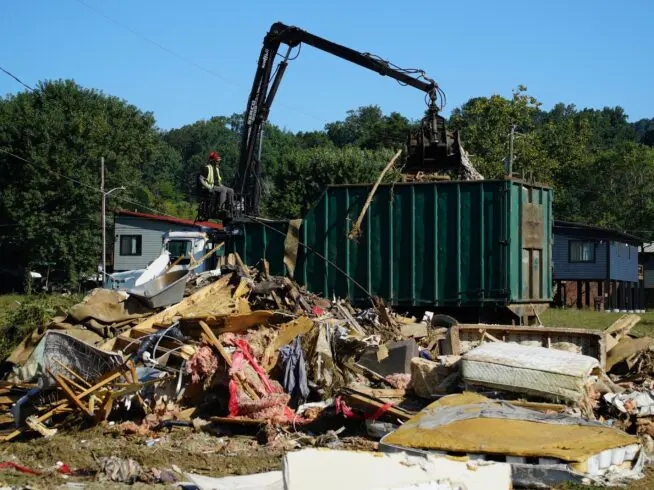
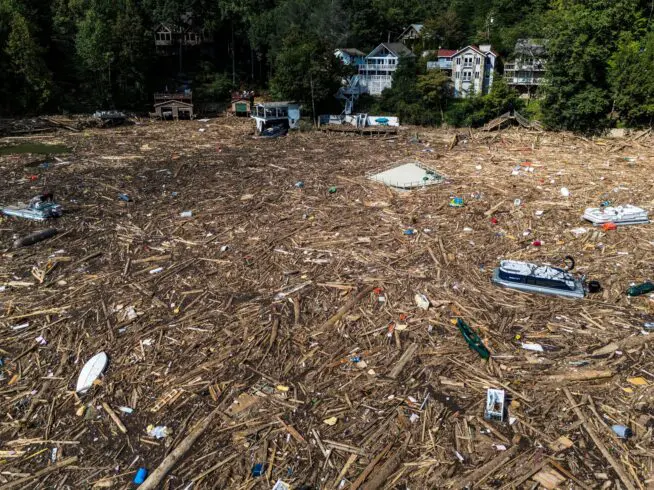
In May 2025, FEMA rejected the state’s appeal to extend full federal reimbursement for debris removal.
Gov. Josh Stein said the denial could cost North Carolina taxpayers hundreds of millions of dollars. He warned that money the state would have to spend on cleanup would leave less funding available to help small businesses, rebuild downtowns and repair water and sewer systems.
The financial strain has continued, alongside the rebuilding.
In a July 18, 2026, update, Stein’s office said 98% of storm-damaged water systems had been restored. It said requests to repair systems and better protect them from future storms, projects estimated to cost more than $758 million, remained unfunded.
For families, recovery has meant a long wait to get home.
Asheville resident Velma Chapman received the keys to her replacement home on July 15, after Helene destroyed the home where she had lived for 28 years. At that point, the single-family housing program under Renew NC, the state’s Helene recovery program, had completed 89 homes. Another 71 were under construction, and more than 390 applicants were in preconstruction.
The governor’s office reported on Aug. 25 that Renew NC and state-funded nonprofit partnerships had completed more than 1,000 homes combined. The state also announced more than $69 million in federal awards to develop 828 affordable apartments across 10 counties. Those units were planned, but not ready for families to move into.
The state budget for fiscal year 2026-2027 passed in July included $40 million for temporary relocation assistance so families could have somewhere to stay while their homes were under construction.
“[Recovery is] going really well at this point in time. We’ve seen over $5 billion in funding that has come into North Carolina, not just from FEMA but also from USDA, from the Small Business Administration, from the Department of Housing and Urban Development,” Whatley told WLOS in September 2025. “When we look at all the different resources that have been coming into North Carolina, we’re very glad. There’s a lot of work to do, but there has been a lot of work already.” Whatley also said he had spoken with officials in affected counties and relayed their concerns to the administration.
FEMA reported more than $2 billion in approved public assistance funding for North Carolina’s Helene recovery as of June 10, 2026. But significant needs remain: On that same day, Gov. Josh Stein requested more than $10 billion in additional federal funding to rebuild homes, repair roads and water systems, and support struggling communities and local economies.
As the second anniversary of Helene’s incursion into North Carolina on Sept. 27, 2024, approaches, the latest state updates show what that unfinished work means: families waiting for housing, communities seeking repair money, and rebuilding projects that will take more time to complete.